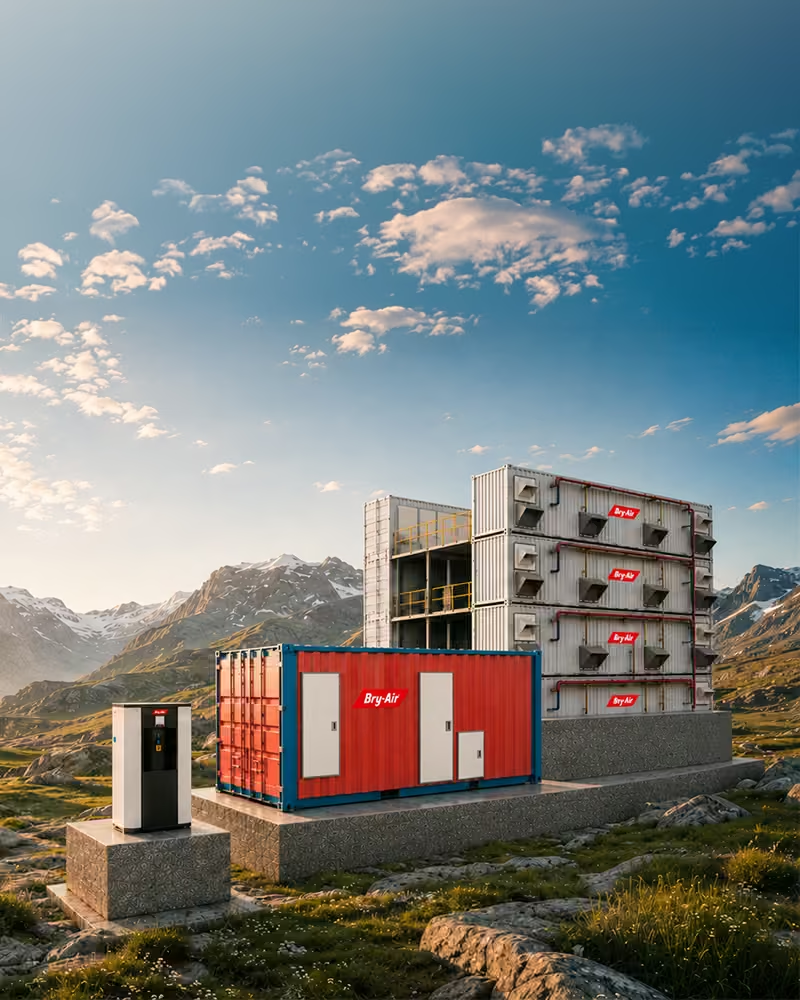
AWG Product Family Mobile

Our Product Family

Download Brochure

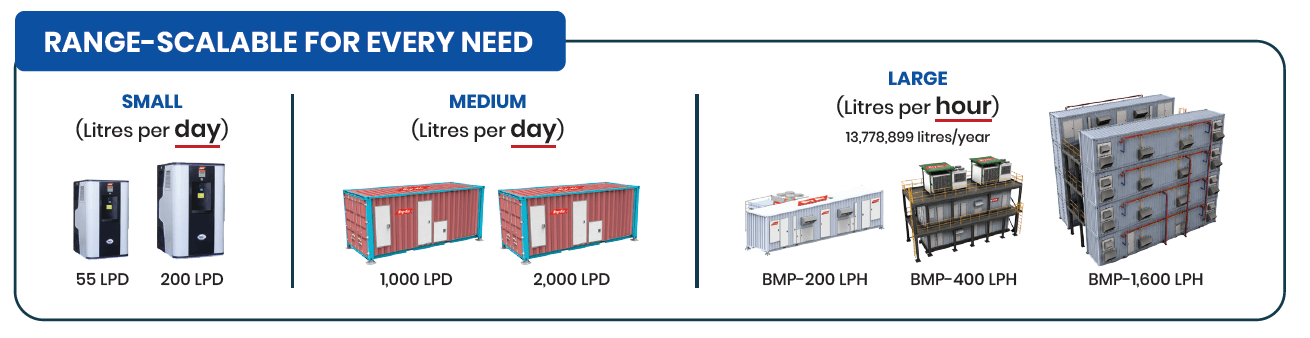
BMP-55 LPD

Compact Standalone AWG

Suitable for :

  • Offices & Institutes
  • Remote locations
  • Small facilities
  • Temporary Camps

Key Specifications

  • Water Output : 55 litres/day
  • Dimensions (LxWxH) : 0.895 x 0.880 x 1.390 mtr.
  • Nominal Conditions : 27°C @ 45% RH, 10g/kg moisture

Compact in size, uncompromising in performance.
Engineered to deliver a dependable source of pure drinking water wherever it's needed.
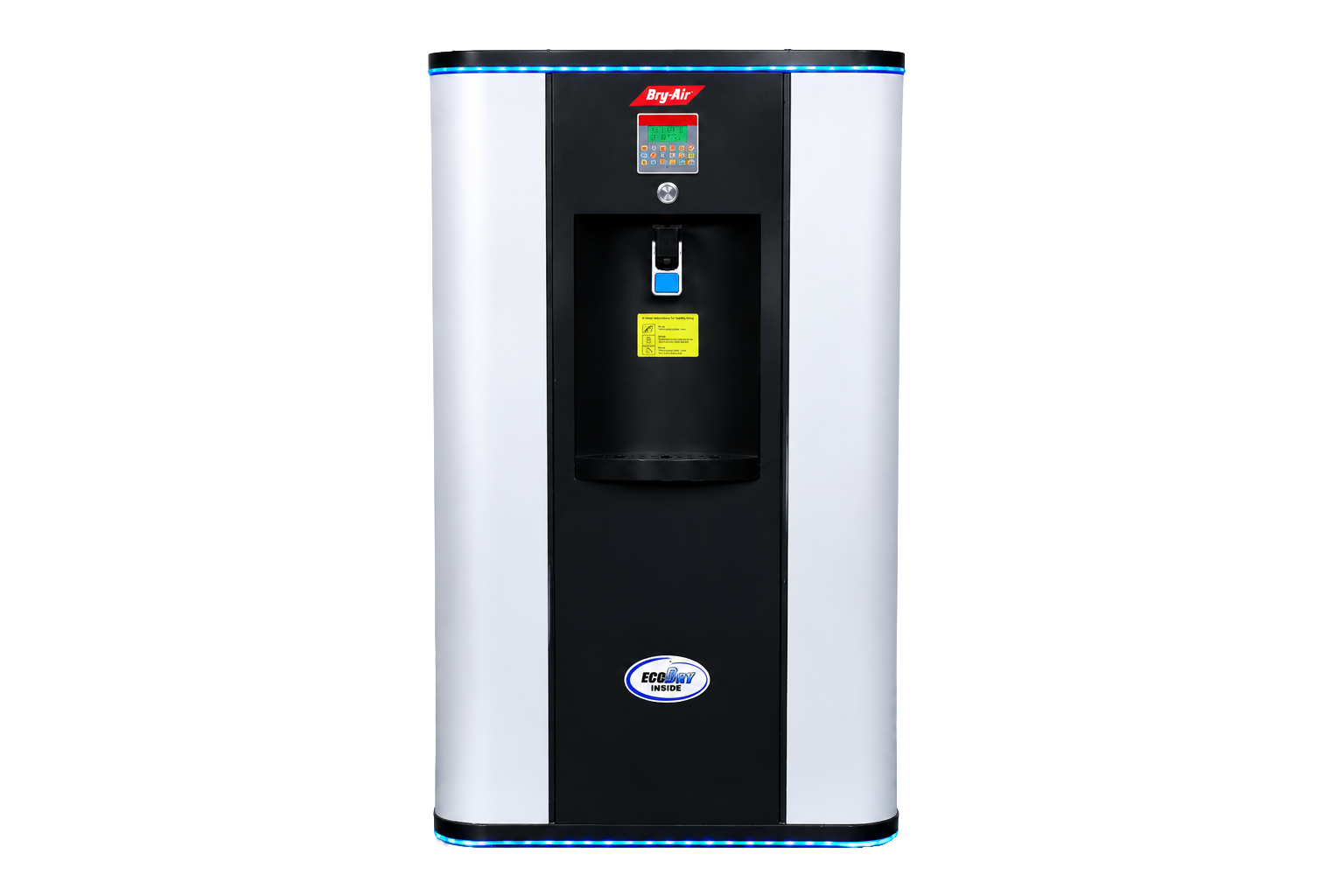
BMP-55 LPD standalone AWG unit

BMP-1000 LPD

Commercial Scale Modular AWG

Suitable for :

  • Manufacturing Facilities
  • Commercial Buildings
  • Remote Luxury Properties
  • Urban Decentralized Water Infrastructure
  • High Value / Controlled Farming

Key Specifications

  • Water Output : 1000 litres/day
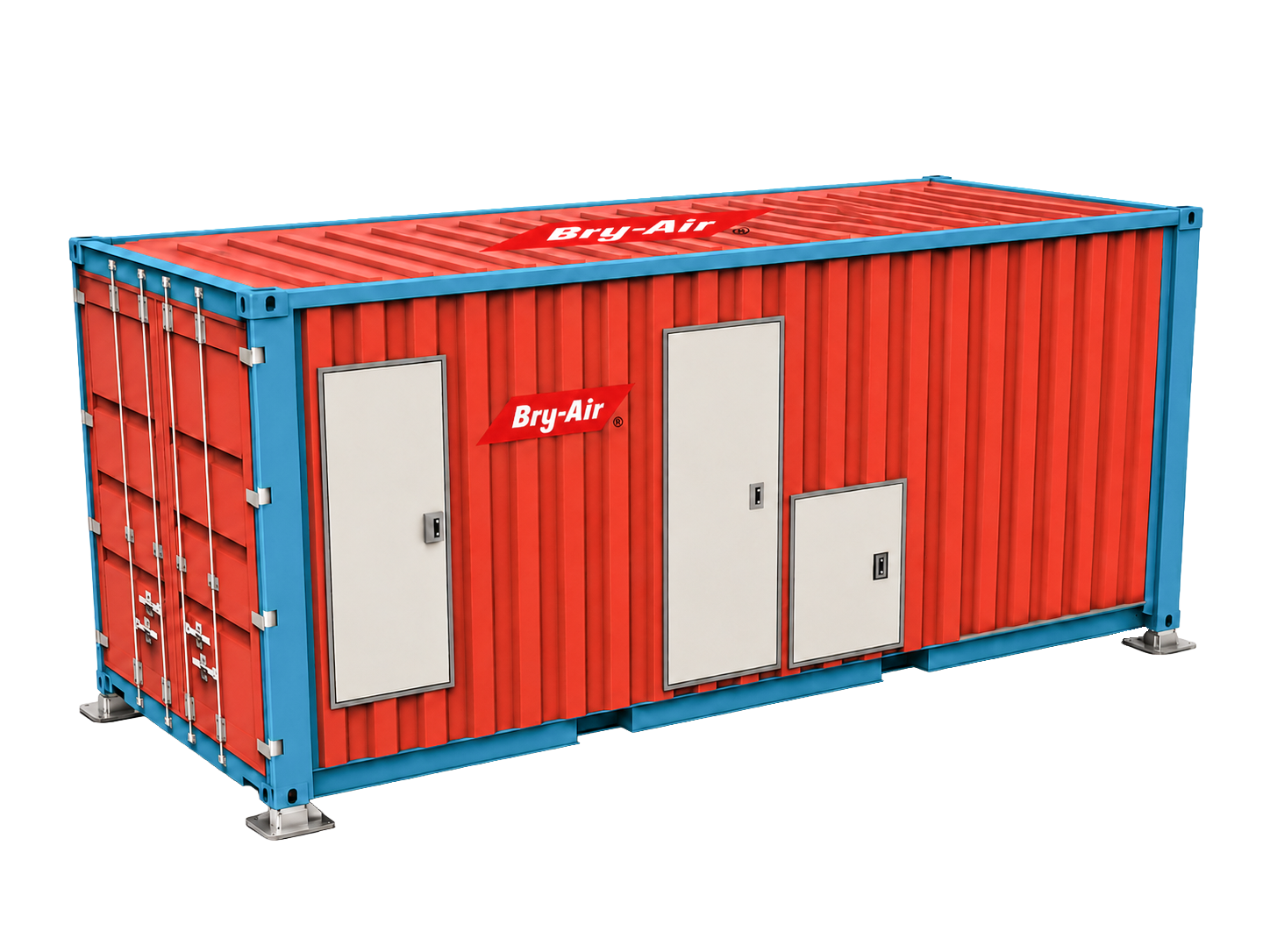
  • Dimensions (LxWxH) : 6.044 x 3.015 x 2.715 mtr. (20 ft. Container)
  • Nominal Conditions : 27°C @ 45% RH, 10g/kg moisture

Built on a modular platform that grows with your water demand.
Expand seamlessly from a single unit to a larger water generation system—without compromising performance.

BMP-1000 LPD modular AWG container

BMP-200 LPH ~ BMP-1600 LPH

Industrial Scale Modular AWG

Suitable for :

  • Datacenter Cooling
  • Island & Costal Communities
  • Remote Industrial Sites
  • Manufacturing Facilities
  • Urban Decentralized Water Infrastructure
  • High Value / Controlled Farming

Key Specifications

  • Water Output : 200 ~ 1600 litres/hour
  • Dimensions (LxWxH) for BMP-200 LPH : 12.190 x 3.530 x 2.900 mtr. (40 ft. Container)
  • Nominal Conditions : 27°C @ 45% RH, 10g/kg moisture

A high-capacity modular platform engineered for industrial-scale water generation.
Deploy one module or many to deliver water anywhere, in any climate, at virtually any scale.

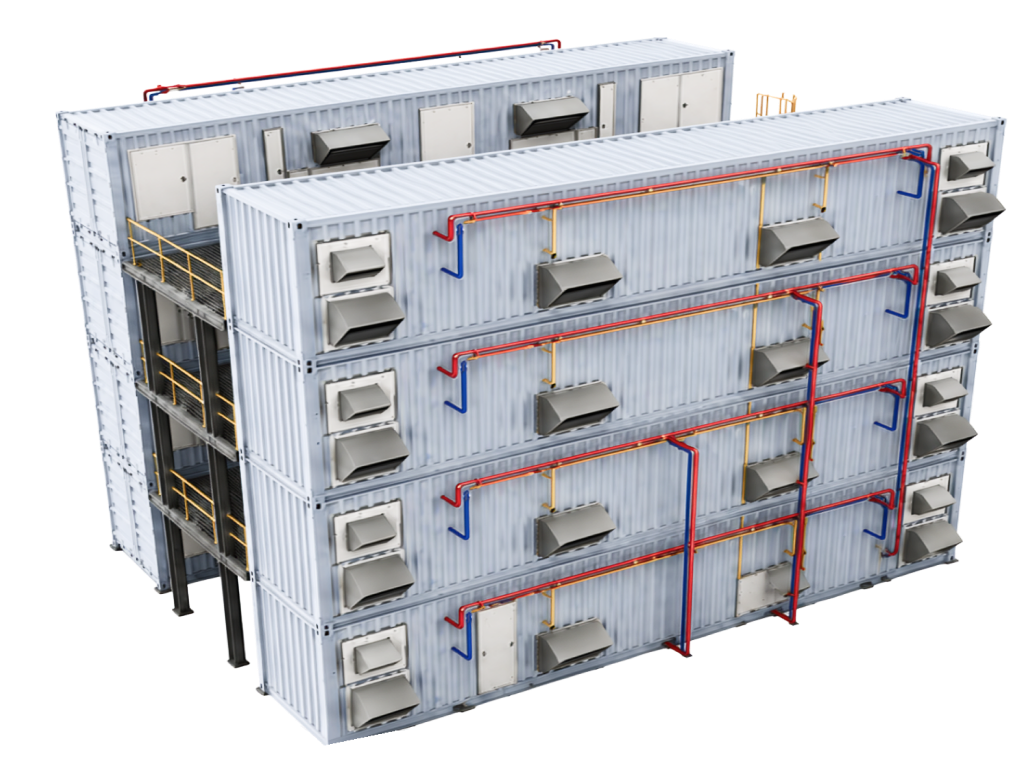
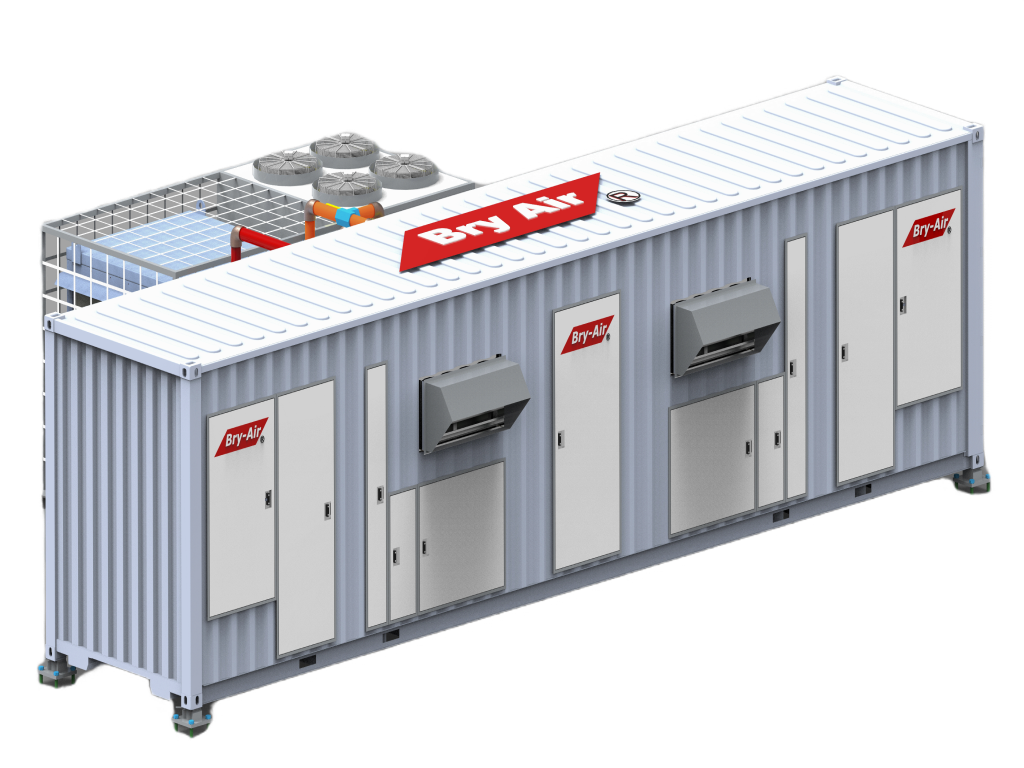
8 x BMP-200 LPH ModuleIndustrial stack of eight BMP-200 LPH modulesBMP-200 LPH ModuleSingle BMP-200 LPH module

Frequently Asked Questions

FAQs on Air Water Generation/ Harvesting

An Atmospheric Water Generator (AWG) extracts water vapour naturally present in the atmosphere and converts it into liquid water.
Instead of depending on conventional sources such as groundwater, rivers, pipelines or water tankers, an AWG uses atmospheric moisture as its source of water.
Bry-Air’s AWG uses an advanced adsorption-based process to capture atmospheric moisture, release it under controlled conditions, condense it and then treat the resulting water.

No. An AWG does not create water from nothing. It recovers water vapour that is already present in the atmosphere and converts it into liquid water.
The atmosphere is a continuously replenished reservoir of water vapour, and AWG technology provides a way to recover a small fraction of that moisture locally.

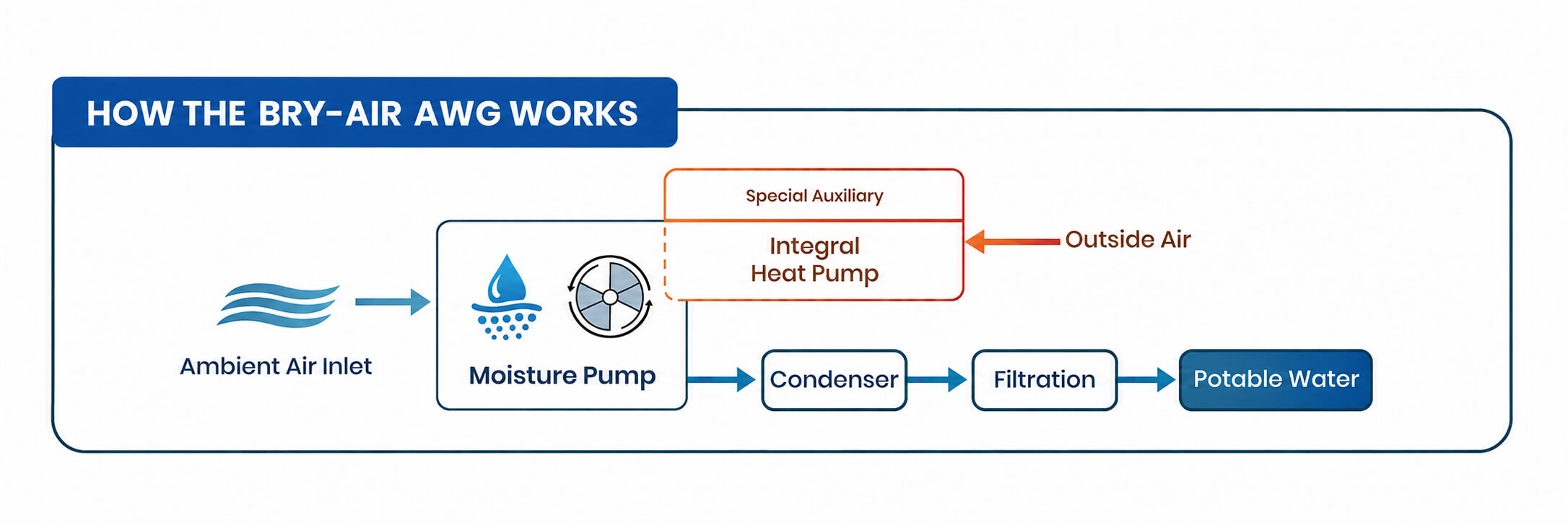
Bry-Air’s AWG operates on an adsorption–desorption cycle.
Atmospheric air passes over a specially engineered adsorbent that captures water vapour. The adsorbent is then regenerated under controlled conditions, releasing the captured moisture as water vapour. This vapour is subsequently condensed, collected and treated.

Bry-Air AWG Adsorption-Desorption Cycle

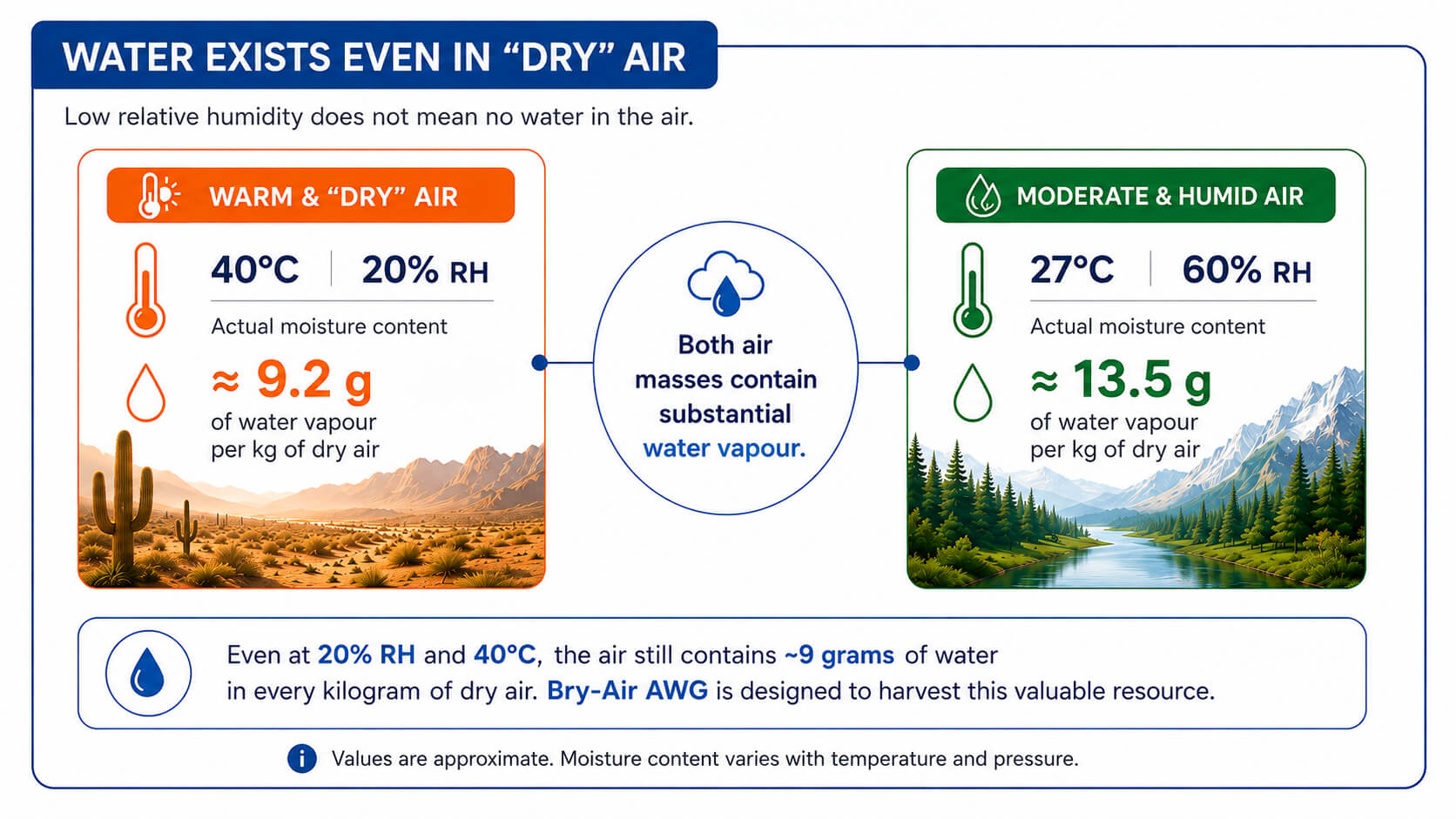
The amount of water vapour present in air depends strongly on temperature and humidity.
Even relatively dry air contains water vapour. Importantly, relative humidity alone does not tell us how much water is actually present: warm air at the same RH can contain substantially more moisture than colder air.
For this reason, AWG potential should be evaluated using temperature together with actual moisture content.

Not necessarily.
AWG is better viewed as an additional, distributed source of water that can complement municipal water, groundwater, rainwater harvesting, wastewater recycling, desalination and other conventional infrastructure.
Its value can be particularly high where conventional sources are unavailable, unreliable, contaminated, depleted or expensive to access.

Yes.
The atmosphere contains water vapour even when relative humidity is low. The key question is not simply whether water is present in the air, but whether it can be harvested at the required rate and cost.
Bry-Air’s adsorption-based approach is specifically being developed to extend atmospheric water harvesting into humid, semi-arid and arid environments.

There is no single minimum RH that meaningfully defines performance for every installation.
Water production depends on a combination of temperature, relative humidity, humidity ratio, airflow, adsorbent characteristics, regeneration conditions, energy availability and required water output.
Bry-Air therefore recommends evaluating the actual climatic conditions of the proposed site rather than relying on a single minimum-RH figure.

Relative humidity indicates how close air is to saturation; it does not directly indicate how much water vapour the air contains.
For example, air at 40% RH can contain significantly different quantities of water vapour at different temperatures.
For AWG, temperature and moisture content must therefore be considered together, often expressed as humidity ratio or absolute moisture content.

Relative Humidity vs Absolute Moisture Content Chart

Not necessarily.
As atmospheric moisture decreases, the amount of water available for harvesting generally decreases. However, an adsorption-based system can continue capturing moisture under lower-humidity conditions.
The actual production rate and economics depend on the complete system design and the prevailing atmospheric conditions.

Yes.
Temperature and humidity change throughout the day, affecting the amount of atmospheric moisture available for harvesting. An intelligently controlled AWG can adapt its operating cycle to changing conditions.
Water storage can also be incorporated so that production and consumption do not have to occur simultaneously.

Yes.
A meaningful assessment can consider the location, temperature and humidity profile, required water output, operating hours, available energy, water-quality requirements and the availability of solar energy or suitable waste heat.
For larger installations, site-specific climatic data provides a much stronger basis for system design than a generic nameplate capacity.

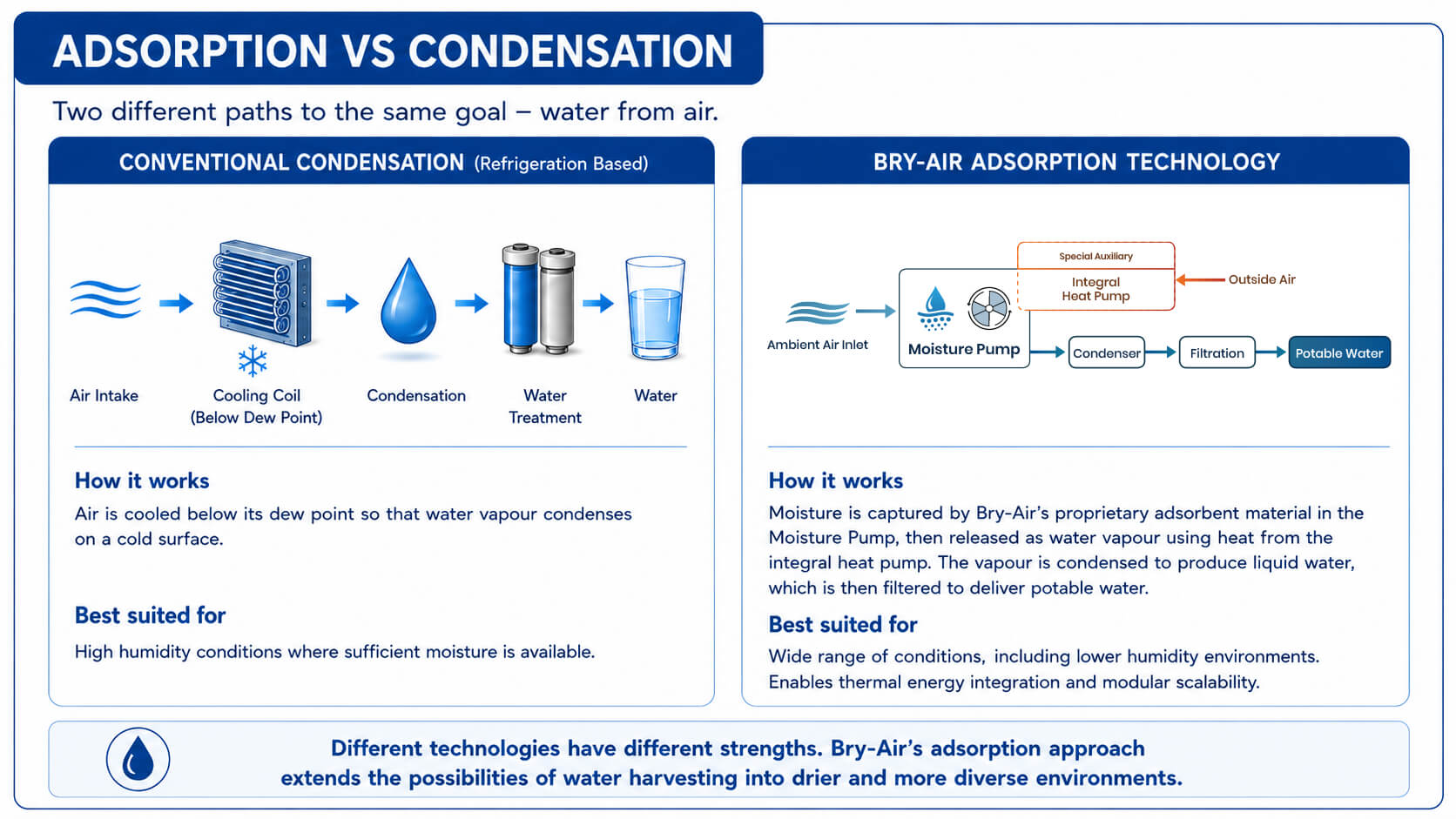
Many AWGs use cooling and condensation: atmospheric air is cooled sufficiently for its water vapour to condense.

Bry-Air takes a different approach by using proprietary adsorbent to capture water vapour directly from atmospheric air. The captured moisture is subsequently released through controlled regeneration, condensed and treated to produce water. The use of a proprietary adsorbent is an important part of Bry-Air's approach, as its adsorption characteristics influence moisture capture, regeneration and overall system performance across varying atmospheric conditions. This approach builds on Bry-Air's decades of expertise in adsorption, desiccant technology, heat and mass transfer and air treatment.

The fundamental process is different.

Both technologies have applications. Bry-Air’s objective is to provide an atmospheric water harvesting platform capable of operating across a broader range of atmospheric conditions, including relatively dry environments.

Bry-Air Adsorption AWG vs Refrigeration-based AWG diagram

As air becomes drier, direct condensation becomes increasingly challenging. Bry-Air's proprietary adsorbent provides another route for capturing water molecules even when the water-vapour concentration is relatively low.

The actual performance depends on the adsorbent characteristics, cycle design, regeneration conditions, heat recovery and overall system efficiency.

Yes, depending on the application.
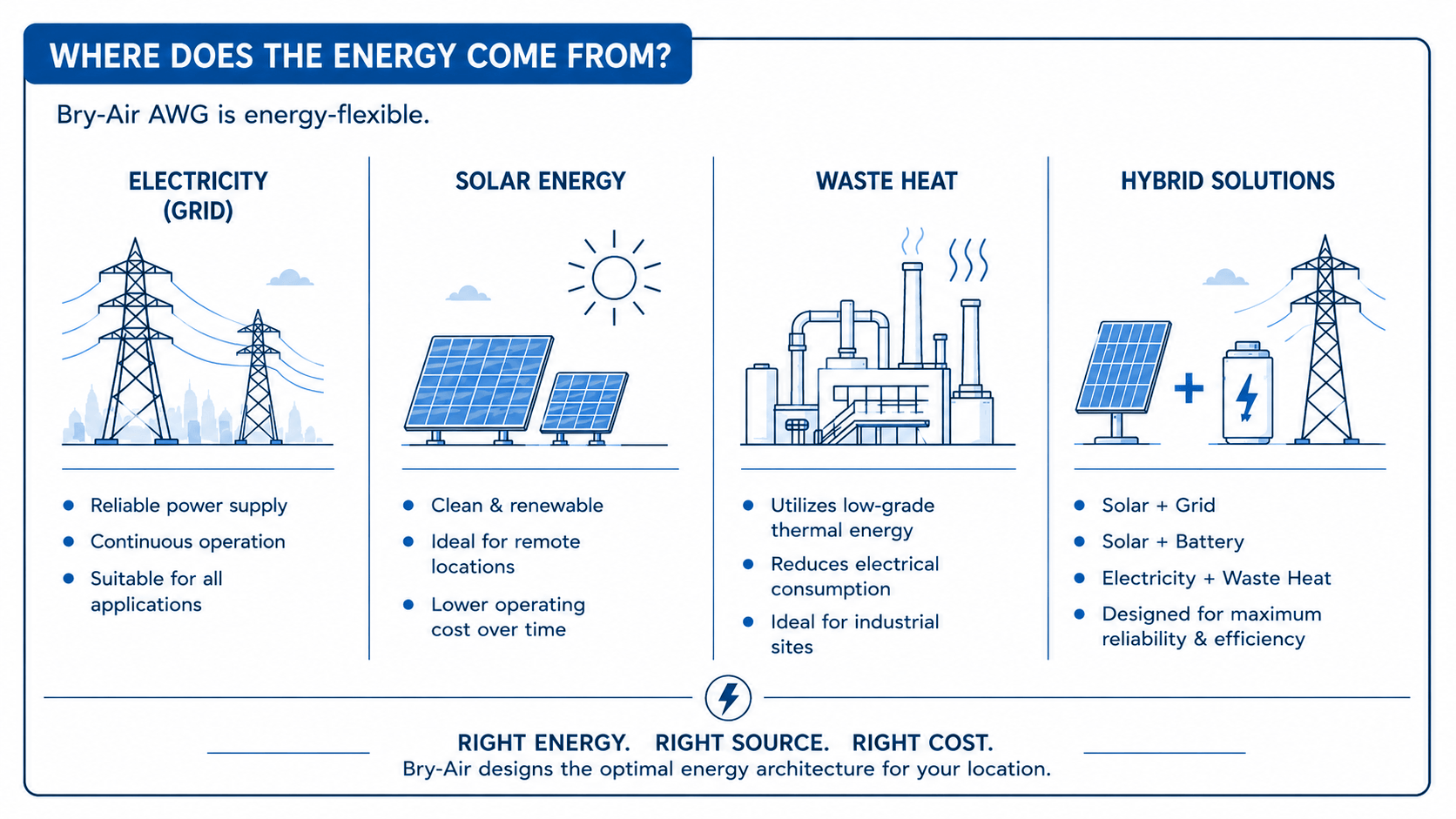
Adsorption-based systems provide an opportunity to use thermal energy for regeneration. Suitable low-grade waste heat from industrial processes, engines, generators or other sources can potentially be integrated into the regeneration process.
AWGs can also be integrated with solar PV, grid electricity, battery-backed systems and hybrid energy configurations.

Renewable Energy and Waste Heat integration with AWG

Atmospheric water harvesting is fundamentally a moisture-management and heat-and-mass-transfer challenge — areas in which Bry-Air has over 6 decades of experience.
That experience includes adsorption, desiccant technology, engineered desiccant rotors, air treatment, adsorption chillers and heat and mass transfer.
AWG applies this underlying expertise to a different objective: instead of removing moisture from air and rejecting it, capture the moisture and recover it as water.

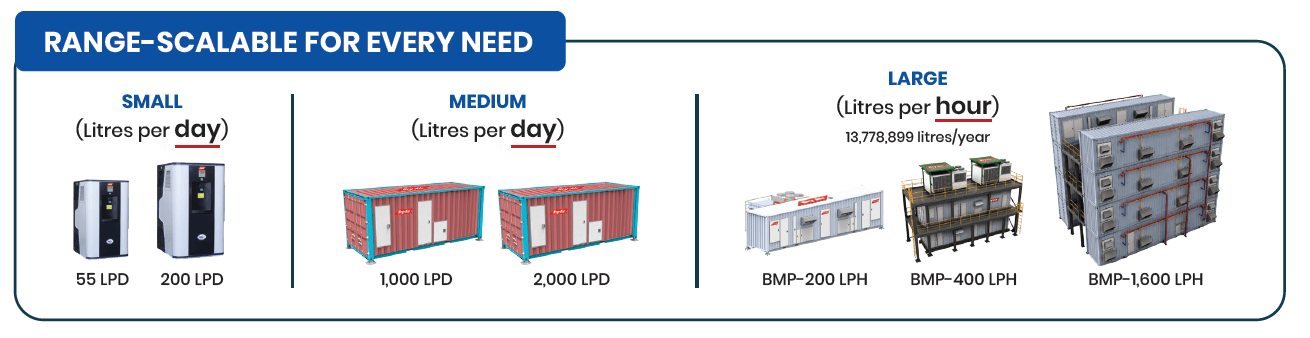
Scale design and modular concept of Bry-Air AWG

Yes, the development philosophy is different.
Bry-Air’s adsorption architecture provides a pathway to modular systems in which capacity can be increased by combining modules, rather than relying only on a single very large system.
The objective is to develop atmospheric water generation as a potential distributed water-infrastructure technology, rather than limiting it to small point-of-use appliances.

Atmospheric water can be treated to meet drinking-water requirements.
However, safety depends on the complete system, including incoming-air filtration, water collection, storage, treatment and sanitation.
The final water quality should be verified against the applicable drinking-water requirements for the relevant country and application.

Yes. Air quality matters.
A properly engineered AWG therefore needs appropriate air-filtration and water-treatment stages, particularly in industrial, urban or polluted environments.
The final water quality depends on both the characteristics of the incoming air and the treatment system selected for the application.

Atmospheric water generally contains relatively little dissolved mineral content compared with many groundwater sources.
Depending on the intended application, the water can be further treated and, where appropriate, remineralized to achieve the desired water chemistry and taste.

Yes.
Depending on the treatment configuration and required water quality, atmospheric water can potentially be used for drinking, institutional use, industrial processes, pharmaceutical applications, laboratories, electrolysis and remote industrial operations.
The treatment system should always be designed around the final water-quality requirement.

Diverse Applications for Atmospheric Water

350~400W/ Litres and with waste heat integration the energy consumption can be reduced to 250~300 W/ Litres.

Performance also depends on temperature, humidity, water-production rate, adsorbent characteristics, regeneration conditions, airflow, heat recovery, operating strategy and energy source.
For meaningful comparison, litres per kWh should always be stated together with the temperature and humidity conditions under which the figure was measured.

It depends on the alternative.
Where low-cost municipal water is readily available, AWG may not be the most economical source.
The economics can change substantially where water must be transported by tanker, pumped from deep aquifers, desalinated, purified, transported over long distances or supplied through expensive infrastructure.
AWG should therefore be evaluated on a total cost-of-water and water-security basis, rather than simply compared with the tariff for conventional municipal water.

Yes, absolutely.
AWG provides an additional source of water without extracting it from aquifers. This can be particularly valuable where groundwater is depleting, saline, contaminated, difficult to access or expensive to pump.
AWG can therefore form part of a broader distributed water-security strategy.

In suitable applications, yes.
Producing water at or near the point of consumption can reduce the need for packaging, transportation and storage associated with centrally produced bottled water.
This can be particularly relevant for defense, institutions, remote facilities, hospitality and other distributed applications.

Yes.

AWG can reduce dependence on groundwater extraction, water transportation and bottled water.
However, an AWG is not automatically sustainable simply because its source is atmospheric moisture. Its environmental performance depends significantly on how much energy is required per litre and where that energy comes from.
Renewable electricity and suitable waste heat can potentially improve the overall environmental footprint.

Yes.
A major objective of the Bry-Air AWG development is scalability. A modular adsorption architecture provides a pathway from decentralized systems to larger water-production installations by combining multiple modules.
This creates the potential to move atmospheric water generation beyond a small-appliance concept towards a distributed water-infrastructure solution.

Decentralized and modular water infrastructure scaling

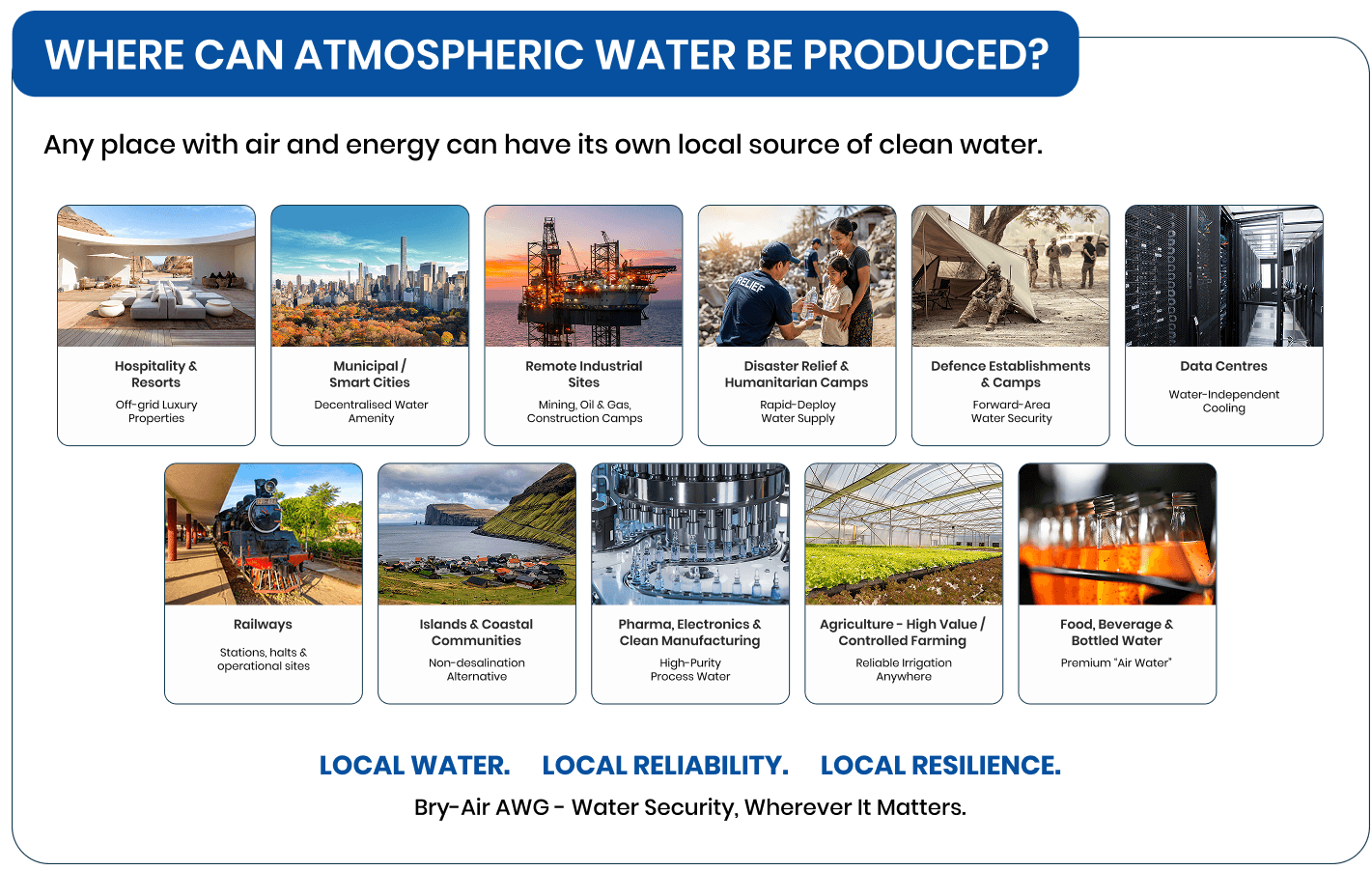
Potential applications include defence, railways, mining, remote industry, infrastructure, hospitals, hotels, islands, disaster relief, remote communities, construction and offshore facilities.
The strongest applications are typically those where generating water locally provides meaningful value compared with transporting or otherwise sourcing it conventionally.

Yes.
Where atmospheric moisture and an appropriate energy source are available, water can potentially be generated at or close to the point of use.
This can reduce dependence on long and vulnerable water-supply chains, making AWG particularly relevant to remote, isolated and strategically important locations.

Not universally.
Different water technologies solve different water-resource problems. Desalination can be highly appropriate where seawater is abundant and very large quantities of water are required.
AWG can be attractive where seawater is unavailable, water transportation is expensive, infrastructure is limited or water is required at remote locations.
The right question is therefore not “Which technology replaces the others?” but “Which combination of technologies provides the most reliable and economical water for this location?”

Water Independence Starts Here

From personal units to industrial-scale systems, Bry-Air AWG delivers reliable water generation wherever it is needed.

Talk To Our Experts