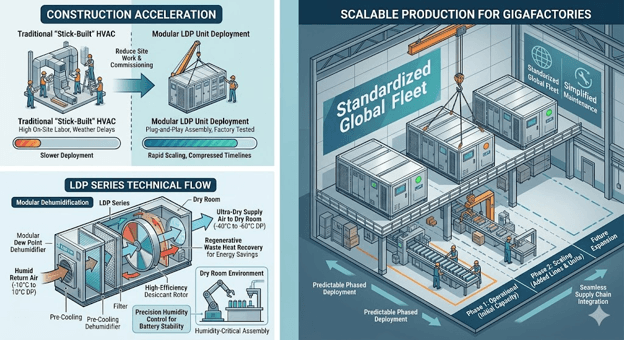
Modular Low Dew Point dehumidifiers are factory-built, factory-tested dry-room units that arrive ready for plug-and-play integration. By moving assembly off-site, they help EPC contractors, OEMs and consultants commission lithium-ion battery dry rooms faster, while holding stable dew points of −40°C to −60°C for cell stability.
The shift to electric vehicles and grid storage has put battery manufacturers under pressure to bring capacity online quickly. For most plants, the dry room is the hardest part of that timeline to engineer – and the part where a missed schedule is most expensive.
Traditional, on-site “stick-built” dehumidification was designed for a slower era of construction. Today, more EPC contractors, OEMs and dry-room consultants are moving to modular Low Dew Point dehumidifiers: pre-engineered units that compress the build schedule without compromising the ultra-low humidity battery cells require.
Why do lithium-ion batteries need a Dry room?
Lithium-ion cells are highly sensitive to moisture during cell assembly and electrolyte filling. Even trace amounts of water can react with LiPF₆ salt in the electrolyte and form hydrofluoric acid (HF). This can degrade cell performance, shorten cycle life, and increase safety risks.
To control this risk, critical battery manufacturing stages are carried out in dry rooms maintained at very low dew points, commonly around −40°C to −60°C. Certain demanding chemistries may require even lower dew-point conditions.
Achieving and maintaining these conditions requires precise, high-capacity dehumidification systems. In a conventional construction model, these systems are custom-designed and assembled on-site. This can increase exposure to weather delays, labour shortages, site coordination issues, and commissioning risks.
How Does Modular LDP Dehumidifier Deployment Change the EPC Build Sequence?
Modular Low Dew Point dehumidifiers are factory-built, factory-tested Low Dew Point dehumidifier units that are delivered ready for site integration. For EPC contractors, OEMs, and consultants, this changes the build sequence by moving a significant part of technical work away from the construction site.
Instead of assembling every major component on-site, the core system is built, integrated, and tested in a controlled factory environment. This reduces project uncertainty and allows dry-room infrastructure to be installed more efficiently once the site is ready.
1. Compressed Timelines and Rapid Scaling
In a gigafactory build, every week of delayed commissioning is deferred revenue. Modular LDP series units are designed for “plug-and-play” functionality. Because the core components-desiccant rotors, refrigeration circuits, and control systems-are integrated into a single frame at the manufacturing facility, the on-site installation time is reduced by up to a significant share of on-site assembly time. This isn’t theoretical. Bry-Air has commissioned dry rooms holding below 1% RH and 10% RH for a lithium-ion battery facility, and delivered −50°C dew-point room conditions (−75°C leaving air) on large North American battery projects, where an independent EPC’s internal comparison confirmed measurable energy savings versus competing desiccant suppliers. We have similar project installations in India as well wherein we had considerable energy savings over other suppliers. Our installed base spans gigascale cell plants, India’s first commercial Li-ion cell production, −60°C room dew-point projects, and solid-state and sodium-ion battery lines.
2. Standardisation Across Global Sites
For companies scaling production across multiple continents, modularity ensures consistency. An LDP unit deployed in North America will operate with the same logic, spare parts, and performance metrics as one deployed in Europe or Asia. This standardisation simplifies training for maintenance teams and reduces the engineering overhead required for each new site.
3. Reduced On-Site Complexity and Labour Costs
Large-scale construction sites are chaotic environments. By shifting the bulk of the technical labour-such as precision welding, electrical wiring, and sensor calibration-to a controlled factory environment, the risk of on-site errors is drastically reduced. This “off-site” approach also mitigates the challenges of finding specialised HVAC technicians in remote regions where many new Gigafactories are being built.
| Factor | Traditional stick-built | Modular Low Dew Point Dehumidifier units |
| Where it’s assembled | On-site | Factory, then shipped |
| On-site install time | Baseline | Reduced (overlaps structural work) |
| Quality verification | First run on-site | Factory Acceptance Tested before dispatch |
| Skilled-labour need on-site | High | Low |
| Scaling to new lines | Re-engineer | Add modular units (phased) |
| Commissioning risk | Higher | Lower |
Deep Dive: Low Dew Point Dehumidification Technology
The LDP series is designed for the latent loads and dew-point precision required in battery dry rooms. These systems are engineered to maintain ultra-low humidity while supporting the stable environmental conditions needed for lithium-ion cell manufacturing.
Multi-Stage Desiccant Cooling
The LDP series utilises a multi-stage approach, often combining high-performance desiccant rotors with integrated pre-cooling and post-cooling coils. This ensures that the air entering the Dry Room is not only dry but also at the precise temperature required to maintain process stability.
Energy efficiency: the dry room is a top operating cost
The dry room is one of the largest energy consumers in a battery plant, so dehumidification design directly affects the total cost of ownership. Bry-Air Low Dew dehumidifiers use energy-recovery and Green Dry Purge technologies to reduce regeneration energy – the same approach that is independently credited with significant energy savings on the North American projects as well as Indian projects as above.
Supply-Chain Advantages: Navigating the Gigafactory Boom
The current global supply chain is under immense pressure. EPC contractors often face lead-time issues for specialised components. The modular LDP dehumidifiers approach offers a strategic buffer against these uncertainties.
- Predictable Lead Times: Because modular units are based on standardised designs, manufacturers can maintain a more predictable production schedule and inventory of critical components.
- Ease of Transportation: Modular LDP dehumidifier units are typically designed to fit within standard shipping dimensions or are built as skid-mounted systems that are easily handled by standard cranes and transport equipment.
- Phased Deployment: Gigafactories are rarely brought to 100% capacity on day one. Modular LDP systems allow for “phased scaling.” As more production lines are added, additional modular units can be integrated into the existing infrastructure without a total system redesign.
Quality Control and Risk Mitigation
In battery manufacturing, a humidity excursion can affect product quality, production yield, and operational reliability. This makes dry-room commissioning a critical project milestone.
With traditional on-site construction, major system validation often happens at the project site under commissioning pressure. Any performance issue discovered at that stage can delay start-up and increase project risk.
Modular LDP dehumidifier units undergo Factory Acceptance Testing before dispatch. This allows key parameters such as airflow, dew-point performance, control logic, and system integrity to be verified in a controlled environment. For EPC contractors, this supports smoother commissioning and reduces the risk of late-stage performance failures.
Proven in real battery dry rooms
Bry-Air Low Dew Point systems are commissioned and operating across the battery ecosystem. These installations demonstrate the ability to support demanding dry-room requirements across different battery applications and chemistries.
A government defence battery laboratory confirmed that Bry-Air dry rooms maintained below 1% RH in one room and 10% RH in another, meeting the required environmental conditions.
On large North American battery projects, Bry-Air units have delivered −50°C room dew-point conditions and −75°C leaving-air conditions. An independent EPC’s internal comparison also confirmed measurable energy savings against competing desiccant dehumidifier suppliers. Similarly, a huge amount of savings were reported for the Dry room they were establishing and the same were verified once the same was commissioned.
Bry-Air’s installed base spans gigascale cell plants, India’s first commercial lithium-ion cell production facility, −60°C room dew-point projects, and newer battery chemistries, including solid-state and sodium-ion battery.
A dew-point claim carries greater value when it is supported by commissioned installations. That is the difference between a specification and a proven system.
Talk to a Bry-Air dry-room engineer for a dew-point and latent-load assessment matched to your site, chemistry and timeline. (Talk to an Expert)
Conclusion
As battery demand expands across electric vehicles, grid storage, and heavy industry, dry-room infrastructure is becoming a core & indispensable part of gigafactory planning. For EPC contractors, OEMs, consultants, and battery manufacturers, the challenge is to build faster without compromising environmental precision.
Modular Low Dew Point dehumidifiers deployment provides a practical way to reduce on-site complexity, improve commissioning confidence, and support phased production growth. By using factory-built and factory-tested systems, project teams can move dry-room infrastructure away from the critical construction bottleneck and toward a more predictable deployment model.
For developers building to aggressive timelines, modular LDP dehumidifier systems offer a faster route to commissioning, verified performance before dispatch, and a scalable foundation for future battery production.
Planning a battery dry room?
Talk to a Bry-Air dry-room engineer for a dew-point and latent-load assessment matched to your site, chemistry, and project timeline.
1. Why is a dry room essential for lithium-ion battery production?
A dry room is essential because lithium-ion cells are highly sensitive to moisture during cell assembly and electrolyte filling. Even trace humidity can trigger chemical reactions that affect process yields, cell performance, reduce cycle life, and increase safety risks.
2. What dew point is typically required in a battery dry room?
Battery dry rooms commonly require dew points between −40°C and −60°C. Some advanced or highly moisture-sensitive chemistries may require even lower dew-point conditions.
3. How does modular LDP dehumidifiers deployment differ from traditional “stick-built” construction?
Traditional stick-built systems are largely assembled on-site. Modular LDP dehumidifiers deployment uses pre-engineered, factory-tested units that arrive ready for integration, reducing on-site complexity and supporting faster commissioning.
4. How much time can modular LDP dehumidifier units save during factory construction?
Modular LDP dehumidifier units can reduce on-site assembly time where project conditions support modular installation. Since major components are integrated and tested before dispatch.
5. What are the quality control benefits of modular units?
Modular units undergo Factory Acceptance Testing before shipment. This allows airflow, dew-point performance, control logic, and system integrity to be checked in a controlled environment before the unit reaches the project site.
6. Can modular LDP dehumidifier systems help with global standardisation?
Yes. Modular systems help standardise operating logic, spare parts, maintenance practices, and performance expectations across multiple sites. This is especially useful for battery manufacturers expanding production globally.
7. How does the LDP series handle energy efficiency?
Modern LDP dehumidifier units include energy recovery systems that repurpose waste heat to regenerate the desiccant wheel. This significantly reduces the total cost of ownership, as HVAC systems are typically the largest energy consumers in a gigafactory along with the Drying equipment.
8. What is “Phased Deployment” in the context of gigafactories?
Gigafactories often start at partial capacity. Modular systems allow for phased scaling, where additional units can be integrated into the existing infrastructure as new production lines are added, without requiring a complete system redesign.
9. How do modular units mitigate labour challenges?
Modular units reduce the amount of specialised technical work required on-site. Tasks such as system assembly, wiring, calibration, and factory-level checks are completed before dispatch, reducing dependency on specialised site labour.
10. Are modular LDP dehumidifier units easy to transport?
Yes. Modular LDP dehumidifier units are generally designed for efficient transportation and handling. They may be configured to fit standard shipping requirements or supplied as skid-mounted systems for easier movement and installation.
Recent Posts